



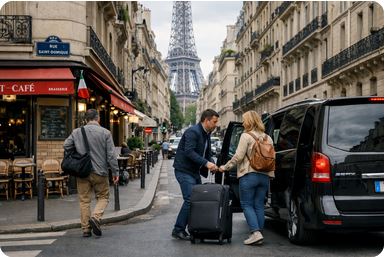
Private transfers from Paris airports to the Eiffel Tower area.
The Eiffel Tower area includes hotels, apartments, residential streets and visitor destinations located on both sides of the Champ de Mars and near the Seine. Access conditions vary according to the arrival airport, the time of day and the exact address within the district.
Transfers from Charles de Gaulle, Orly and Beauvais airports involve different road approaches and travel constraints. Local access may also be affected by pedestrian activity, temporary restrictions, major events and limited stopping space near some landmarks.
The suitability of each transport option depends on traffic, passenger mobility, luggage, arrival time and the final destination within the district. Providing a complete hotel name or street address helps determine a more appropriate route and drop-off point.
Quick comparison of transport options to the Eiffel Tower area
| Option | Price basis | Journey conditions | Practical considerations |
|---|---|---|---|
| 🚆 Train and metro | Public transport fares depend on the selected route | Depends on connections, waiting times and walking distance | May involve stairs, platform changes and a final walk with luggage |
| 🚖 Taxi | Metered or regulated fare depending on the airport and route | Direct road journey subject to traffic | Pickup conditions and final access depend on the exact destination |
| 🚐 Private transfer | Pre-booked rate based on the route, vehicle and passenger requirements | Pre-booked direct journey subject to traffic and local access | Vehicle size and pickup arrangements should match the group and luggage |
Prices and journey conditions may vary according to the selected route, travel date, traffic, passenger count, vehicle type, airport terminal and exact destination.
Understanding the Eiffel Tower transfer zone
The district combines large open spaces around the Champ de Mars with hotels, offices, apartments and residential streets behind Rue Saint-Dominique and Avenue de la Bourdonnais. This layout influences the final approach and the stopping point available near the requested destination.
Vehicle circulation may be less constrained on major roads but more limited near the Seine riverbanks, Trocadéro viewpoints and areas with dense pedestrian activity. Temporary traffic restrictions, major events and local access conditions can affect the route.
A destination entered only as “Eiffel Tower” may not be precise enough to determine an appropriate drop-off point. Passengers should provide a complete hotel name, street address or identifiable entrance, particularly when access near the monument is restricted.
More detailed information about local routes is available in the transfer guide for the Eiffel Tower area.
Public transport can provide access to several stations around the district, but the final segment may require walking or an additional connection. Its suitability depends on the exact destination, luggage and passenger mobility.
Streets and landmarks within the Eiffel Tower transfer area
- Rue de Grenelle – residential and institutional addresses south-east of the Champ de Mars
- Rue Saint-Dominique – hotels, restaurants and residential addresses near the northern side of the district
- Musée du quai Branly – cultural destination close to the Seine and the Eiffel Tower
- Pont de l’Alma – river crossing connecting the district with the Right Bank
- Champ de Mars – large pedestrian area with several possible approach points
Access conditions vary between residential streets, cultural sites, river crossings and pedestrian areas. A broader overview of the sector is available in the Eiffel Tower district guide.
Nearby transfer areas: Chaillot & Trocadéro area | Invalides district | Champs-Élysées area
Connections and nearby districts
The Eiffel Tower area connects with Chaillot and Trocadéro across the Seine, Invalides to the east and the Champs-Élysées area farther north. Each destination involves different bridges, boulevards or riverbank approaches.
The appropriate approach depends on the final address. A hotel near Trocadéro, an apartment behind Avenue de Suffren and an entrance near Champ de Mars may require different river crossings and local access routes.
Road access from Paris airports and local journey conditions
Road conditions vary according to the arrival airport. Journeys from CDG generally approach Paris from the north, routes from Orly use southern access points, and travel from Beauvais involves a longer approach before entering the Paris road network. In every case, traffic, river crossings and local access near the final address can affect the journey.
Road-based services provide direct access but remain dependent on traffic, availability and local pickup or drop-off conditions. Train and metro routes may involve connections, waiting periods and a final walk from the nearest station.
Transfers from all Paris airports
Each Paris airport requires a distinct approach to the Eiffel Tower area:
- CDG Airport: northern road approach with conditions depending on traffic around the A1, the périphérique and central Paris access points
- Orly Airport: southern approach with conditions depending on the A6, the southern périphérique and Left Bank access
- Beauvais Airport: longer intercity approach requiring additional planning before reaching central Paris
The final approach should be planned from the full destination address rather than from the Eiffel Tower landmark alone.
Choosing a transport option for your travel requirements
- 🧳 Multiple bags: consider the number of connections, walking distance and available luggage space
- 👨👩👧👦 Group or family: check vehicle capacity and whether the group needs to remain together
- 💸 Budget considerations: compare the full fare and any additional connections
- ⏱️ Time constraints: allow for traffic, waiting times and local access conditions
- 🌙 Late arrival: verify service availability and pickup arrangements in advance
The most suitable option depends on the balance between cost, connections, luggage, passenger mobility, service availability and the exact destination.
Planning an airport transfer to the Eiffel Tower area
Reaching the Eiffel Tower area requires identifying the exact destination and considering the different access conditions from CDG, Orly or Beauvais. Traffic, pedestrian activity, temporary restrictions and limited stopping space may influence the final approach.
Before travelling, confirm the full address, passenger and luggage requirements and the pickup arrangements associated with the selected transport option.
Local stopping conditions may change during major events or temporary traffic restrictions.